
Laura Siebert — Business Systems Architect
Most problems aren't effort problems.

Whether you're running your own services or leading a team, the gap between effort and result is almost always structural. I build tools and audits that name the break and point to where to start.
for in-house creative teams
The creative is strong. The numbers aren’t.
A fixed-scope, 4-week audit that builds the system connecting your creative team's work to paid social performance: brief, variation, review, and learning loop.
For marketing teams
The team is busy. No one can see if it's working.
A fixed-scope, 4-week audit that gives marketing teams a clear picture of how work actually gets planned, decided, and shipped, plus the 3–5 changes to make next.
For Freelancers & Solo Operators
You’re working. The numbers don’t work.
A spreadsheet-based decision tool that shows you your required hourly rate, how many clients you can realistically support, and what's holding your income back.
For freelancers and solo operators
You're working. The numbers don't work.
More clients won't fix this. Neither will working harder. If your income is falling short, the issue is almost always structural: your pricing doesn't support your goal, your capacity is capped, or the model itself can't do the math you need it to do.
The Service Revenue Planner is a spreadsheet-based decision tool that shows what your current model can and can't do. Put in your rate, your capacity, and your income target. It tells you your required hourly rate, where the gap is, and what's actually capping your income.
Not a budget template. Not a motivational tracker. A revenue model diagnostic for operators who want a clear read on their numbers.
What it generates
01 Required hourly rate
02 Maximum monthly revenue at your current rate
03 Clients you can realistically support
04 Hourly rate shortfall
05Monthly income gap
06Your biggest current constraint
07Recommended next move
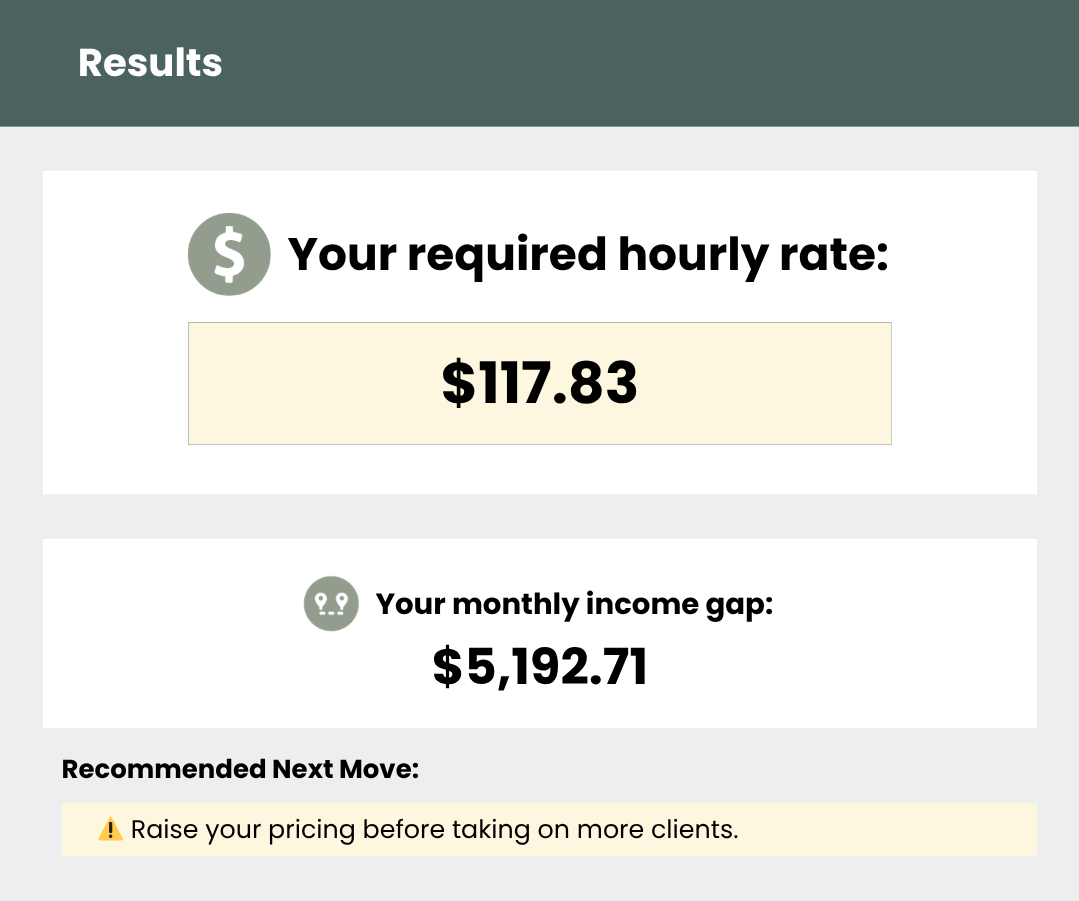
Sample Output
"Client capacity is currently your biggest constraint."
"Your pricing is significantly below what your income goal requires."
Every output comes from your inputs. No invented diagnostics. No fake dashboards. What you see is what the math says.
For marketing & in-house creative teams
Two audits. Different Scope. Different buyer.
Both are fixed-scope, 4-week engagements. Both deliver a clear read and a plan you can act on. The difference is what they examine and who they're built for.
for in-house creative teams
Performance Creative Audit: Design to Perform
For Creative Directors and Brand Directors whose in-house creative team is producing strong work that isn't connecting to the market.
For marketing teams
Marketing Systems Audit
For Marketing Directors and Ops Leaders who need an outside read on how their team actually works: how work gets planned, decided, and shipped.
For marketing teams
You can see the work. You can't see the system running it.
Most marketing audits look at outputs: campaigns, channels, metrics. This one looks at the operating system underneath: how work gets planned, decided, coordinated, and shipped. Most dysfunction doesn't live in the outputs. It lives in the structure that produces them.
The Marketing Systems Audit is a fixed-scope, 4-week engagement for marketing teams that have outgrown their current operating picture. It's built for teams that are producing, but leadership can't tell if it's adding up, decisions keep getting dropped or relitigated, and no one has a shared view of what's actually happening.
Not strategy consulting. Not execution support. A structured read on how your team works, and a plan your team can act on.
4-week process
01
Kickoff
Scope alignment, stakeholder scheduling, document request.
02
Interviews
Up to 5 stakeholder conversations. Systems and tool review.
03
Analysis
Pattern synthesis. Findings and recommendations drafted.
04
Delivery
Audit deck. 90-minute working session. 30-day follow-up window.
built for
Marketing leaders running lean teams without dedicated ops support
Creative teams producing high volume without consistent systems
Directors who inherited a function and need an outside read
Teams coordinating across departments with no shared operating picture
What’s Included
→ Up to 5 stakeholder interviews
→ Full review of your existing systems, tools, and documents
→ Audit deck: findings, recommendations, and prioritized next steps
→ 90-minute working session to walk through the audit together
→ 30 days of clarification questions after delivery
What's not included:
Implementation, retainer work, open-ended consulting, or creative critique. You get a clear read and a sequenced plan. What happens next is yours to decide.
$5,000 flat. 4 weeks. 50% on kickoff, 50% on delivery.
The intake form takes five minutes. If we're a fit, I'll respond within two business days.
For in-house creative teams
The creative is strong. The performance data isn’t.
Most paid social performance lives or dies on the creative. Most in-house creative teams don't have a system for understanding what's connecting to the market, why it's connecting, and what to change next.
Performance data lives in one tool. Creative work lives in another. The brief, the variations, the review process, and the post-campaign learning loop run in parallel, not in conversation. The team makes more. The numbers don't move.
The Performance Creative Audit looks at the system around the work: brief quality, variation logic, review process, and how market response flows back to the team. By the end of four weeks, the team has a diagnosis and four operating tools they own and run after delivery.
Not a taste-based critique. Not a media buying service. A specific read on the system around your creative work, and the tools to change it.
All creative work should be expressive of the brand and the intent behind it. This isn't about limiting creativity. It's about making sure the work is supported by a system that allows it to do what it's meant to do.
The Five areas the audit covers
01
Brief quality
Does the brief tell the team what the work is supposed to do, who it's for, and what success looks like?
02
Variation system
Are variations testing meaningful differences - message, hook, hierarchy, offer - or just aesthetic ones?
03
Design-for-performance fundamentals
Hierarchy, message match, readability, CTA visibility, placement alignment.
04
Feedback and review process
Is feedback grounded in the goal of the work, or in personal taste?
05
Learning loop
Does market response ever reach the creative team? Does the next round get better because of the last one?
What you walk away with:
→ Audit deck: findings, diagnosis, recommendations, and prioritized next steps
→ Performance-calibrated brief template
→ Variation framework
→ Review checklist
→ Learning loop protocol
→ 90-minute working session
→ Notion workspace with all four operating tools — yours to run after delivery
$5,000 flat. 4 weeks. 50% on kickoff, 50% on delivery.
Optional add-on: +$1,500 for up to 5 stakeholder interviews (available at booking only).
About
Laura Siebert.
I'm a Business Systems Architect with 15+ years across marketing, creative operations, product management, and founder roles. My work is built around one principle: you can't fix what you can't see.
Most recently, I was Director of Marketing at Meow Wolf Houston, where I built the campaign planning and coordination system that aligned creative, operations, retail, and guest experience teams. Before that, I led project management at Padrón & Co. I founded and scaled a direct-to-consumer business from $80K to $500K in eight months. Product Management certified through Product School.
The tools and audits I build start from the same premise: most problems aren't effort problems, they're structure problems. My goal is to give you a clear picture of what's actually happening so you can make a better decision about what to do next.

20+ years experience across marketing, ops, product, and design
Former Marketing Director Meow Wolf Houston
Scaled a DTC business $80K → $500K in 8 months
Product Management certified Product School
Three offerings. One operating principle.
Whether you're running your own services, leading a marketing team, or managing an in-house creative function: the question is the same. Does your current structure support what you're trying to do? If you don't have a clear answer, that's where to start.